
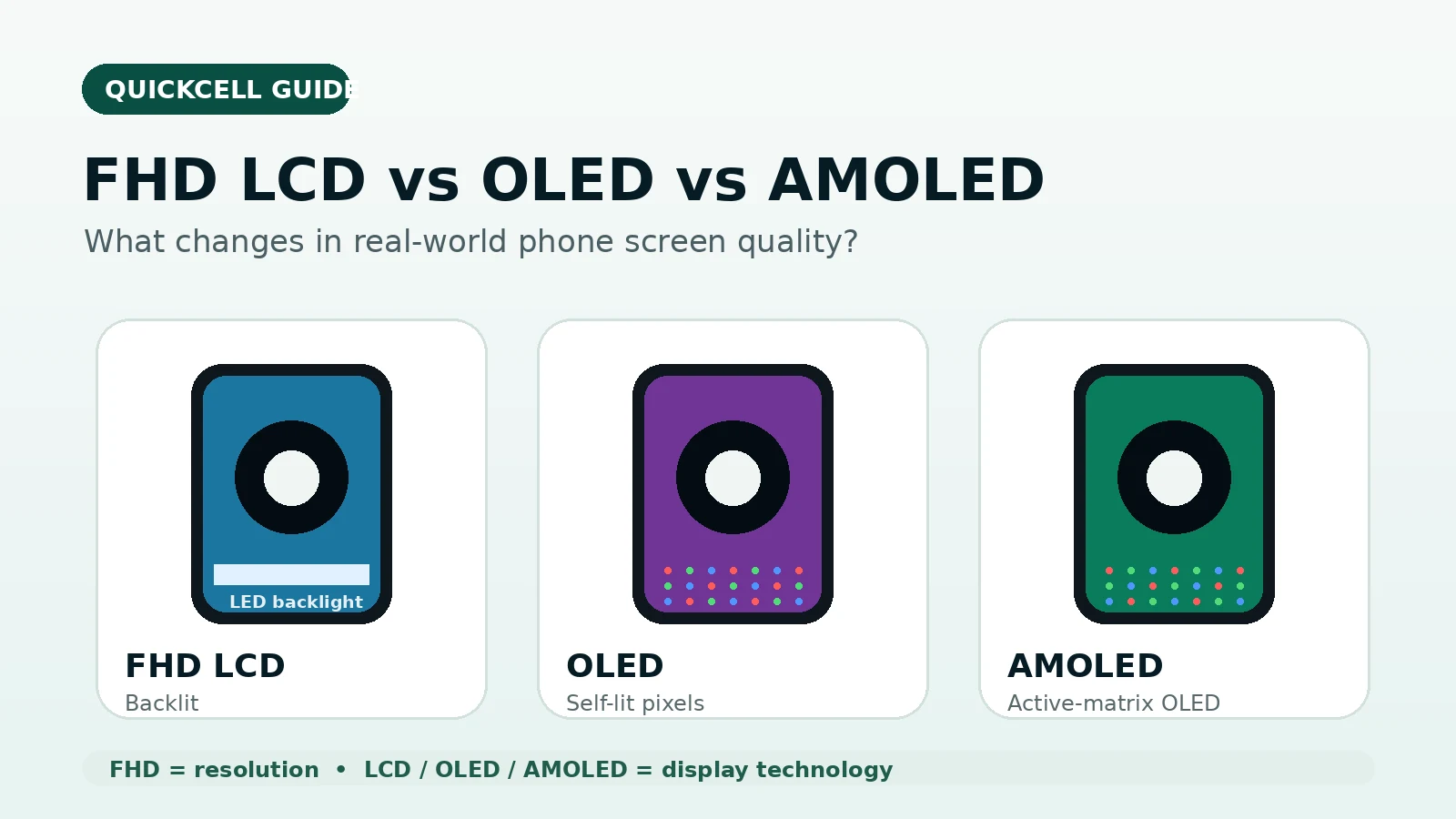
If you are choosing a replacement phone screen, you may see labels such as FHD LCD, OLED, Soft OLED, Hard OLED or AMOLED. They can sound like competing grades, but the first thing to know is that FHD describes resolution, while LCD, OLED and AMOLED describe how the display produces an image.
FHD is a resolution, not a display technology
FHD means Full HD. A standard Full HD image is 1920 × 1080 pixels. On phones you may also see FHD+, which usually means a taller version of Full HD because modern phones use wider aspect ratios.
This means a display can be FHD LCD, FHD OLED or FHD AMOLED. The term FHD does not tell you whether the screen uses a backlight or self-emitting pixels.
ViewSonic's Full HD specification example lists Full HD as 1920 × 1080, while Japan Display's display basics guide explains the pixel structure used in TFT LCD and OLED panels.
What is an LCD phone screen?
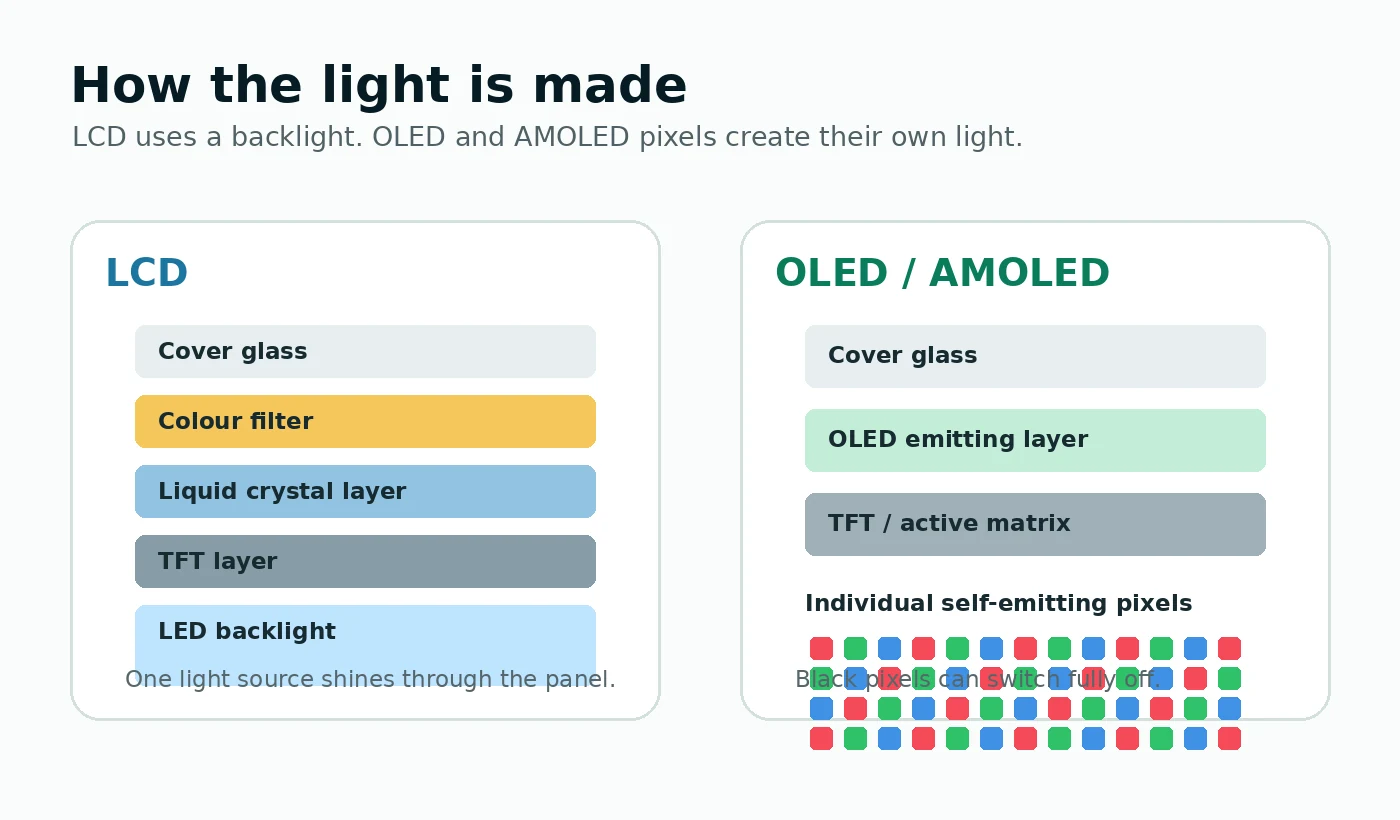
LCD stands for Liquid Crystal Display. The liquid crystals do not create light themselves. An LCD therefore needs a backlight behind the panel.
The backlight shines through layers including the liquid-crystal layer, colour filters and polarizers. The display controls how much light passes through each sub-pixel to create the picture.
Japan Display describes a TFT LCD as having a backlight behind the panel, with thin-film transistors controlling the voltage applied to individual sub-pixels.
Advantages of LCD replacement screens
- Usually the lowest-cost repair option
- Widely available for many phone models
- Can provide sharp resolution and good everyday usability
- Does not rely on organic self-emitting pixels
Things you may notice compared with OLED
- Black areas may look more dark grey than completely black
- Contrast is normally lower because a backlight is still operating
- The panel assembly can be thicker
- Colour, brightness and viewing angles depend heavily on the quality of the replacement part
For a customer mainly looking for a cost-effective repair, a good-quality LCD can make sense. However, if the phone originally used OLED, an LCD conversion may not look or feel exactly like the original screen.
What is OLED?
OLED stands for Organic Light Emitting Diode. OLED is different from LCD because its pixels are self-emitting. There is no separate backlight required.
When a pixel needs to show black, it can switch off rather than trying to block light coming from behind it. This is why OLED is known for strong contrast and deep blacks.
Japan Display describes OLED as a self-emitting display technology associated with high contrast, fast response and thin construction. LG UK also explains that OLED pixels create their own light and do not require a backlight.
Advantages of OLED replacement screens
- Deeper blacks
- Stronger contrast
- Thin display construction
- Fast pixel response
- Usually a closer visual match when the original phone came with OLED
Things to consider
- OLED replacements normally cost more than LCD
- Quality can vary significantly between aftermarket manufacturers
- Organic display materials can age over time
- Choosing the cheapest part labelled “OLED” does not automatically guarantee original-equivalent quality
What is AMOLED?
AMOLED stands for Active Matrix Organic Light Emitting Diode.
It is a type of OLED display in which an active-matrix backplane controls the pixels. In modern smartphones, active-matrix technology is extremely common because millions of pixels need to be controlled quickly and efficiently.
Samsung's official explanation states that AMOLED means Active Matrix Organic Light Emitting Diode. Samsung also uses the term Super AMOLED for displays where the touch function is integrated with the AMOLED display.
Samsung UK – AMOLED explanation
Is AMOLED better than OLED?
Not in the simple way that “AMOLED is always better than OLED”.
AMOLED is a type of OLED architecture, not a completely separate technology competing against OLED. In phone-parts listings, different manufacturers may use terms such as OLED, AMOLED, Soft OLED and Hard OLED to describe the panel construction or product grade.
The actual quality of a replacement screen depends on more than the label. Brightness, colour calibration, touch response, refresh behaviour, thickness, glass quality and compatibility all matter.
LCD vs OLED vs AMOLED at a glance
FHD / FHD+
- Describes resolution
- Does not tell you the panel technology
- Can be used with LCD or OLED-type displays
LCD
- Uses a backlight
- Usually cheaper
- Good option when repair cost matters most
- Normally cannot match OLED black levels
OLED
- Uses self-emitting pixels
- No separate backlight
- Better black levels and contrast
- Usually costs more than LCD
AMOLED
- An active-matrix type of OLED
- Common in modern smartphones
- Shares OLED's self-emitting pixel advantages
- The word AMOLED alone does not tell you the replacement part's overall quality
Which replacement screen should you choose?
The best choice depends on your phone and what you want from the repair.
Choose LCD when
- You want the most affordable repair
- The phone originally used LCD
- You are happy to trade some display quality for a lower price
Choose OLED when
- Your phone originally came with an OLED screen
- You care about deeper blacks and stronger contrast
- You want a display experience closer to the original technology
Choose the highest-quality compatible option when
- Display quality matters more than the lowest repair price
- You use the phone for photos, video, gaming or colour-sensitive work
- Features such as fingerprint sensing, high refresh rate or specific display calibration need to work correctly
At Quickcell, we recommend comparing the actual replacement part specification, not just the headline name. Two parts both labelled “OLED” can still differ in construction and quality.
What do Soft OLED and Hard OLED mean?
You may also see Soft OLED and Hard OLED in repair-price lists.
These terms normally describe the type of substrate and construction used by the replacement panel rather than the resolution. Soft OLED panels use a more flexible construction, while hard OLED panels use a more rigid structure.
The right option depends on the phone model, available replacement parts and budget. We will cover Soft OLED vs Hard OLED in a separate Quickcell guide.
Frequently asked questions
Is FHD LCD better than OLED?
FHD and OLED describe different things, so they cannot be compared directly. FHD describes resolution; OLED describes display technology. An OLED screen can also have Full HD or Full HD+ resolution.
Is AMOLED the same as OLED?
AMOLED is a type of OLED. The “AM” means Active Matrix, referring to how the pixels are controlled.
Why is an OLED screen replacement usually more expensive?
OLED panels use self-emitting organic display technology and are generally more expensive replacement components than basic LCD alternatives. The final repair price also depends on the phone model and the quality of the replacement part.
Will an LCD replacement work on a phone that originally had OLED?
For some phone models, aftermarket LCD conversion screens are available. They can reduce repair cost, but image quality, thickness, power behaviour and some features may differ from the original OLED screen. Compatibility should be checked for the exact model before fitting.
Sources and further reading
This guide uses public technical information from established display manufacturers:
- Japan Display Inc. — Display Basics: LCD, TFT LCD and OLED
- Samsung UK — AMOLED display explanation
- LG UK — What is OLED?
- ViewSonic UK — Full HD 1920 × 1080 specification example
Quickcell note: Replacement-screen terminology can vary between manufacturers and suppliers. Always check the specification of the exact replacement part offered for your phone model.